South Vallejo Residents Fear Possible “Coal Trains” as Mysterious Company Could be Eyeing Our Port
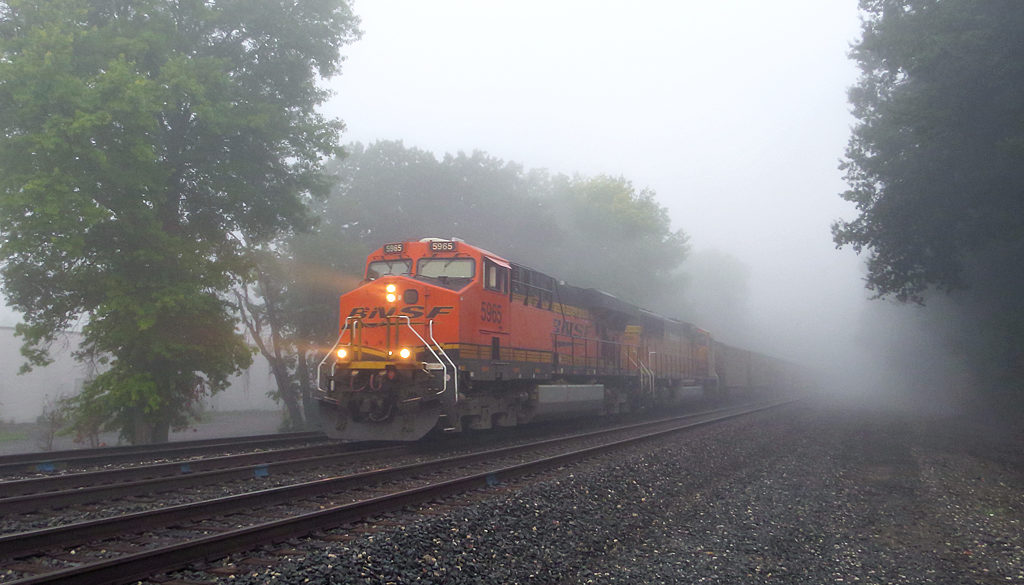
“Foggy Coal Train” by amtrak_russ is licensed under CC BY 2.0
It’s a worry that’s always been on the back-burner of Fresh Air Vallejo (FAV) and the Sierra Club: Trainloads of coal rolled in from the rest of country to Vallejo to load onto ships headed for China. Vallejo has the deep-port space required for major coal tonnage. It also has the Sperry Mill site and the Kiewit Pacific Company Vallejo Yard, which already runs a coal extraction business in Wyoming.
But FAV’s yellow caution light turned to red when the Press Democrat reported in September that a “mysterious” company knows as North Coast Rail had proposed re-opening defunct rail lines throughout Northern California in order to begin shipping the stuff overseas. Counties such as Alameda, Humboldt, Sonoma, Mendocino and Marin already moved into overdrive to try and head off any coal shipping off at the pass by either enacting resolutions opposing coal trains in their area or scrambling to do so. Guess which county is not on that list?
Both Vallejo and Richmond are home to deep water ports, which are necessary for such shipments. Our deep water port is what initially drew ORCEM our way, hoping to ship its “clean cement” from our shore.
The City of Richmond, in Contra Costa County, has been in litigation with coal-shippers because it failed to pro-actively bar their transport. The city’s Levin Richmond Marine Terminal sees trains carrying coal from Utah every week, according to KPIX-5. Richmond passed an ordinance in 2020 that gradually phases out over three years the storage and handling of coal; it is being challenged in court.
In an amicus brief in support of the City of Richmond filed by California State Attorney Xavier Becerra in May 2020, the state alleges that a million tons of coal move through the Levin Terminal per year. KPIX-5 cited U.S. Census Bureau figures that showed an increase in coal shipments from the port from 120K metric tons in 2016 to 738,000K tons in 2018, an increase of 615 percent over two years.
Wolverine Fuels filed a claim against the City of Richmond in March of 2020 to try and get the ordinance overturned. It is still in court.
Our deep-water port sits at the edge of south Vallejo, and now residents of that area and environmental activists are hoping that the City of Vallejo can move quickly to pass an ordinance of its own barring any coal shipments.
FAV member Peter Brooks told me that he sees it as an “environmental justice” issue. North Vallejo already has higher-than-average levels of childhood asthma and other unhealthy air concerns. In fact, according to the Times-Herald, Solano County has the highest asthma rates in the entire state.
One problem is the coal dust that these shipments expel. KQED covered the coal dust issue in Richmond in 2015, citing a BNSF Railway study that found that every uncovered coal car can lose between 500 pounds and one ton of coal in transit. Richmond residents told the news outlet that their houses and cars were always covered in coal dust.
I reached out to Richmond City Council Member Eduardo Martinez, who has been active in the fight against the coal trains, but have not heard back.
Concerns over Vallejo’s lack of any coal ordinance are being re-animated now that the Press Democrat has reported about a “mysterious” LLC, North Coast Rail Company, that filed a pleading with the Surface Transportation Board to ship coal from Wyoming to Humboldt Bay. I did some digging on North Coast Rail and found that the LLC has an office address in Sheridan, WY, with as many as 39 other LLCs under the same roof. A Google search of the address shows a small, nondescript building in a strip mall that was an H&R Block at least in 2019. In order to restore rail lines to ship the coal, North Coast Rail would have to spend over an estimated $2 billion dollars, fueling speculation that the entity behind it has deep pockets.
In September of this year, the Salt Lake Tribune published a story about an internal Utah port agency document that pointed to coal industry actors in both Utah and Montana as being involved in the project, as well as the Crow Nation and the Humboldt-Bay based Wiyot Tribe. The Utah agency and the Wiyot Tribe have since “distanced themselves” from the proposal, according to Congressman Jared Huffman.
In a statement on Huffman’s government page, he says that the Utah agency’s CEO, Jill Flygare, said that “After fact checking, it was determined it was not a viable port project and we’ve had no participation since.” The Wiyot Tribe now opposes the the project as well, he said.
In addition to Huffman’s opposition to the project, State Senator Mike McGuire has introduced SB 307 to stop any coal port and to bar any tax dollars going to it.
While other counties scramble to pass ordinances, Vallejo’s deep water port stands wide open. Once a deal is made to ship the coal— over federal rail lines— there’s not much a city can do except sue, as Richmond has. But by passing an ordinance pre-emptively, Vallejo could prevent any coal shipments by train, several sources told me.
I reached out to Vallejo Marine Terminal, which runs the Derr St. “Old Sperry Mill” site with the deep port, but have not heard back yet. I also reached out to Kiewit for comment and have not heard back yet.
Sierra Club Redwood Chapter Vice-Chair Joe Feller said his organization would like to see a “scenic corridor” along our strait, not heavy industry.
“We’d like to protect it as a valuable resource, not only for economic growth, but for our currently quality of life,” he said.
Do you appreciate my reporting? Please consider supporting me on Patreon. You can learn more by hitting this link.


October 27, 2021 @ 8:01 pm
Haven’t we discovered years ago we needed to ban coal from the earth, and look at China still using coal and no country wants too do anything about this, they poison our animals nothing done then they poison babies formula nothing done. What do they have to do before someone stops them???